

Google introduced Gemini 4 Carbon for tougher coding jobs and cybersecurity work. Google says it can sustain complex engineering tasks for days, with access starting among selected cyber defenders and trusted partners before a wider rollout. Read more
OpenAI launched GPT-6.1 Terra, a faster model built to understand screens and work across computer apps. It improves coding and factual accuracy while costing half as much per token as GPT-5.6 Terra, making everyday automation cheaper. Read more
Google DeepMind unveiled Genie 4, which generates interactive worlds with sound and dialogue. You can explore with keyboard controls and change scenes using text, with access beginning as a research preview for trusted testers. Read more
Anthropic filed an S-1 registration statement for a proposed initial public offering. The preliminary filing says it has applied to list on Nasdaq under ANT, while the share count and offer price remain unspecified. Read more
OpenAI announced AI-generated research results in mathematics, computer science, and physics. It is working with outside experts to examine and explain the findings, including a claimed refutation of the Exponential Time Hypothesis, a major assumption about how hard some computing problems are. Read more
NVIDIA released Nemotron 3.5 Transcribe, an open-weight model for turning audio into text in 40 languages. It handles recordings up to an hour long and supports translation, speaker labels, and timestamps, giving builders more tools for meetings, interviews, and media. Read more
Baidu released Unlimited OCR 2 to extract information from very long documents. It processes multiple pages together and keeps a compact working memory, helping it read lengthy files without letting memory use grow as quickly with every new page. Read more
Tencent’s Hy-SimulMT translates spoken Chinese and English while the speaker is still talking. It produces translated text and speech while preserving the speaker’s vocal characteristics, aiming to make live meetings and interviews feel less interrupted. Read more
Do you prefer to watch instead of read? Check out this video covering the top AI news this week:
Liquid AI launched LFM3, a family of small open-weight models for text, images, audio, and decision tasks. The text model fits in about 1 GB when compressed to four-bit precision, and the family is designed for local customization and use on devices. Read more
SenseNova-Loop-9B-Preview is a compact model that reads text and images for document, coding, and tool-based tasks. It reuses part of its own network for a second processing pass, adding computational depth without storing a second copy of those layers. Read more
SenseNova 6.8 Code2Video makes short videos by writing and running code. That gives creators direct control over text, timing, and motion, with model weights and a production workflow available for researchers to explore. Read more
Nanbeige released a 33-billion-parameter model focused on coding and professional assistant work. The team also plans to use it as a teacher for smaller models, passing down useful skills so future versions can run with fewer resources. Read more
DiffuSpace released Clover-35B-A3B-Preview, an open model that generates text in blocks rather than strictly one token at a time. It targets fast coding and tool use, with the team reporting 515 tokens per second on a single H200 in its agent-task tests. Read more
Apex Intelligence launched Apex-35B-V1.0 for coding, agent tasks, and scientific research. AI helped develop the model by designing experiments and analyzing training results, and the release demonstrates research workflows involving robotics and fluid simulations. Read more
Spark-X2.6-1.7B brings improved coding, planning, and tool use to a small model designed for local devices. Developers can choose among three thinking levels to trade response speed for more reasoning, without changing the underlying model. Read more
AutoSwarm connects different AI agents so they can share context and work as a team. It selects agents for subtasks, coordinates their work, and combines results, reducing the need to repeat instructions across separate tools. Read more
NVIDIA’s SimReady Assets library offers 2,677 downloadable 3D objects for simulation projects. The collection includes everyday and industrial items, giving developers ready-made building blocks for virtual environments. Read more

GLM is Z.AI’s flagship open-source model built for long, difficult engineering tasks like coding, debugging, and autonomous agent work. It delivers top-tier performance while being dramatically cheaper and faster than frontier closed models. Get 10% OFF HERE.
GrootTeam’s model collection offers several AI models that take both images and text as input. The lineup includes multiple sizes and compressed formats such as GGUF and FP8, giving developers options for different hardware setups. Read more
RoboSkills gives AI agents a practical toolkit for robotics and simulation work. Its five workflows cover tasks such as rebuilding demonstrations in simulation, generating motion, and testing robot actions, bringing several specialist tools into one package. Read more
MatAnyone-E separates people from video backgrounds while preserving fine details such as hair. By concentrating processing on uncertain regions, it reaches about 28.6 frames per second at native 4K on an H200 in the researchers’ tests. Read more
Open-H3-Regenerate-2K is an open tool for redrawing low-resolution AI video at higher quality. It supports output up to 4K for clips of 5 to 15 seconds, helping creators sharpen detail while keeping the draft’s content and motion. Read more
Audio8-TTS-Realistic adds more expressive speech and support for 23 languages in a compact voice model. Its listening demos compare cloned voices across several systems, showing how a small model can handle varied delivery and emotion. Read more
Sperid Labs’ Idol turns a single image into a 3D object you can view from different angles. It builds the object from tiny colored blobs called Gaussian splats, offers adjustable detail, and runs in under 8 GB of GPU memory. Read more
Paradee 1.2 packs four English voices into the same 8.5 MB speech model. It adds American and British voices while preserving the previous voice’s measured quality, making local read-aloud apps more flexible without a larger download. Read more
Google researchers proposed a sleep phase to help AI remember new information over time. The model alternates between active use and offline practice that stores recent knowledge more permanently, aiming to learn new facts without erasing older skills. Read more
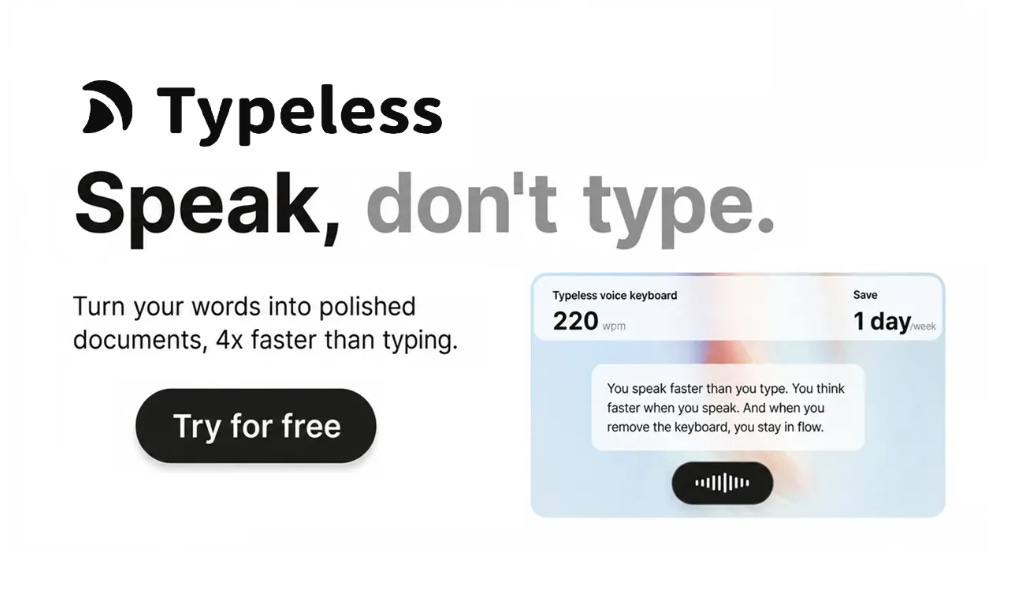
Typeless is an intelligent AI voice dictation tool designed to turn your speech into polished, well-structured text in real time. It automatically cleans up your speech by removing filler words like “um,” fixing mid-sentence corrections, and formatting lists across various apps and devices. Try it for free today!
NVIDIA’s MotionBricks generates character movement using a model trained on more than 350,000 motion clips. Its reusable controls combine navigation and object interactions, making it easier to assemble complex animation without handcrafting every transition. Read more
Mundo turns a few images of a place into an editable world you can explore and simulate. It combines a simplified 3D scene, a physics simulator, and video generation to show interactions and support robot testing in customized environments. Read more
PhysAg3D turns a single image into a detailed 3D object with moving or responsive parts. It combines a 3D generator with an AI agent that proposes interactions and refines the asset, creating plausible objects for virtual demonstrations and simulation. Read more
OverSeer helps multiple AI-controlled players share a more consistent generated world. It adds fixed camera views as shared reference points, helping places stay stable and making one player’s actions visible to the others. Read more
Stanford’s UniAction lets one world model respond to several kinds of action controls. It brings forces, camera movement, hand poses, and robot poses into a shared system, helping researchers combine controls that usually require separate models. Read more
StreamVibe studies video assistants that notice when help is needed as a task unfolds. Its model and benchmark track changing user goals and task progress, aiming to offer timely guidance without waiting for a fresh question every time. Read more
SceneBloom generates realistic furnished rooms for training AI agents to navigate indoor spaces. It combines AI-generated layout ideas with geometric checks, and the researchers report that training in its rooms improved navigation in unseen real-world scans. Read more
Mol-1 is an open model for predicting the 3D structures of biological molecules and their complexes. It accepts proteins, DNA, RNA, and other molecular components, with prediction and fine-tuning tools that researchers can run on their own hardware. Read more
Meet Fish Audio, the most expressive AI voice model. Core features include text-to-speech, instant voice cloning, and a library of over 2 million voices. Create natural, emotionally rich AI voices built for your workflows. Try it for free.